Turkey,[a] officially the Republic of Türkiye,[b] is a transcontinental country located mainly on the Anatolian Peninsula in Western Asia, with a small portion on the Balkan Peninsula in Southeast Europe. It shares borders with the Black Sea to the north; Georgia to the northeast; Armenia, Azerbaijan, and Iran to the east; Iraq to the southeast; Syria and the Mediterranean Sea to the south; the Aegean Sea to the west; and Greece and Bulgaria to the northwest. It also shares a maritime border with Cyprus to the south.
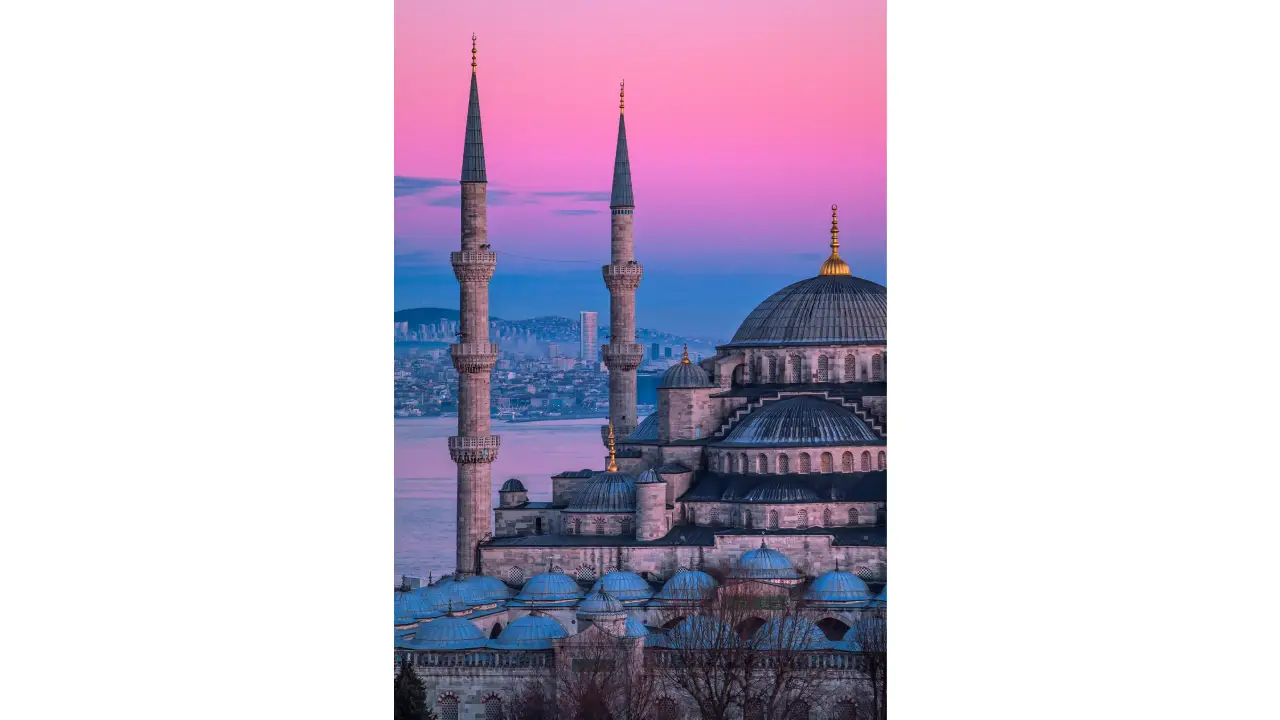
Turkey is a republic. There are 81 provinces in Turkey. The money of Turkey is called the Turkish Lira. The capital city is Ankara, a city in the central region, called Anatolia. The cultural and economic centre is in the European side of Istanbul. In the past Istanbul was called Constantinople. The republic was founded in 1923, after World War I and a war of independence (Kurtuluş Savaşı). Before that, Turkey was the core of the Ottoman Empire.
Many civilisations were in the area that is now Turkey, like the Hittites, the Roman Empire and the Byzantine Empire. Many important events in the history of Christianity happened in places that are now in Turkey. Because it lies in both Europe and Asia, some people see Turkey as the “door” between them. The vast majority of the Turkish population believes in the religion of Islam.
Modern Turkey’s varied climate lets many kinds of food crops grow, and livestock and forestry are important industries. Turkey makes enough food to feed itself. Turkish manufactures include aeroplanes, electronics, cars, clothing and textiles for home and for other countries.
Turkey is a popular place for tourists to visit. It has hundreds of kilometres of beaches on its Aegean and Mediterranean coasts, and many important historical places.
History
Ancient Anatolia
The first major empire in the area was the Hittites (from the 18th century to the 13th century BCE). The Hittites, who spoke one of the Indo-European languages, developed a high culture in Central Anatolia. Their kingdom was destroyed by the Sea People in the 11th century BCE and the successor states were Lydia, Caria and Lycia.
From 1950 BCE, Armenians and Assyrians inhabited parts of southeastern Turkey. The Assyrian capital was named Tushhan (900-600 BCE). The Assyrians ruled over southeastern Turkey until their empire was conquered by Babylonia in 612 BCE. Then Anatolia became home for various kingdoms including the Achaemenid Empire, Hellenistic kingdoms, Roman Empire, Byzantine Empire (Eastern Roman Empire), Seljuk Empire, and Mongol Empire.
The Ottoman Empire
Main article: Ottoman Empire
During the 14th century, after the fall of the Mongol Empire, Gazi Osman built a new empire named after himself: the Ottoman Empire. It became one of the longest existing empires of all time. The Empire also stretched across the Balkans, (Yugoslavia and Bulgaria) in Europe. The Empire was ruled by Islamic law, but other religions had certain minority rights.
In World War I the Ottoman Empire was one of the Central Powers. During the war, 500,000 Armenians in the Ottoman Empire were massacred in the so-called Armenian genocide. Turkey denies that the event was genocide. The Central Powers lost the war and the Ottoman Empire was destroyed, but after that Atatürk led the newly formed Turkish army to get rid of foreign enemies, like the Greeks and ousted the imperial Ottoman family from Anatolia.
Republic of Türkiye
Mustafa Kemal Atatürk was the first President of Turkey. He made many changes that made Turkey more modern. But some people did not like some of the changes that made life in Turkey more secular. Religious secondary schools were gotten rid of, for example. The opponents to Atatürk felt that he weakened Islam in the country. Later political disputes led to Coup d’état in 1960, 1971, and 1980, and several failed attempts.
In 1974, Turkey launched an invasion of Cyprus and later established the Turkish Republic of Northern Cyprus, Rauf Denktaş became the first Turkish Cypriot president.
On 15 July 2016, a coup d’état was attempted.
In 2022, the government of Turkey started to use the Turkish spelling of Türkiye in both Turkish and English. However, Turkey remains the more common name.